
蛋白序列扩散模型详解
从 token、PLM latent、结构 token 到进化编辑,梳理蛋白序列扩散模型的噪声空间、关键公式和代表论文。
蛋白序列扩散模型,一言以蔽之,把序列弄乱(加噪),再恢复原样(去噪)。
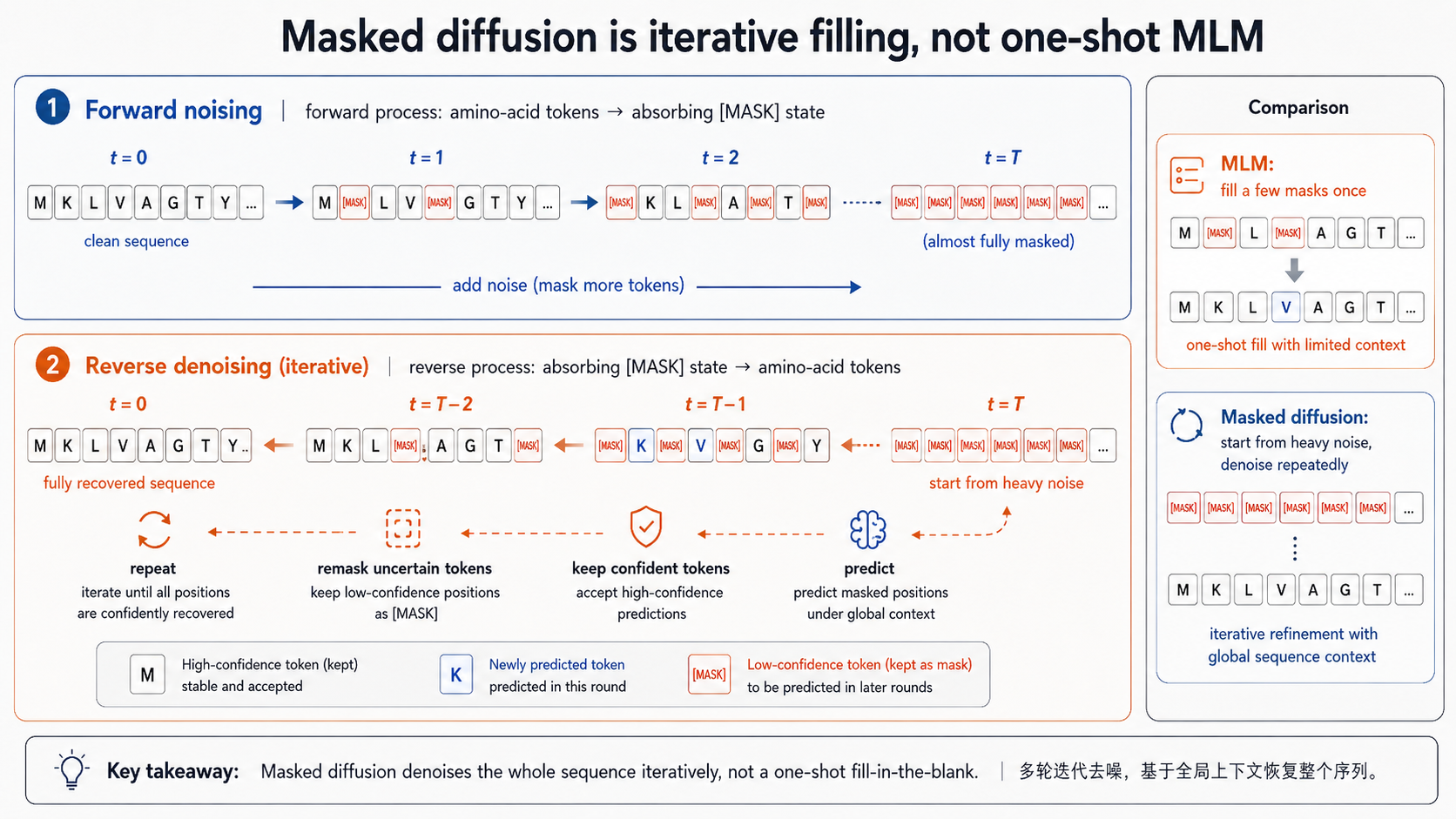
它确实是填空题,但不是一次性填空。masked diffusion 把整条序列逐步 mask,再多轮去噪。每个残基的答案都依赖全局上下文,因为一个位置会牵动远处的折叠、口袋、电荷和跨膜区。
把一条蛋白写成 \(x=(x_1,\dots,x_L)\)。\(x_i\) 是 amino-acid token。前向过程把干净序列 \(x_0\) 变成噪声序列 \(x_t\)。反向过程学习 \(x_t\rightarrow x_0\)。
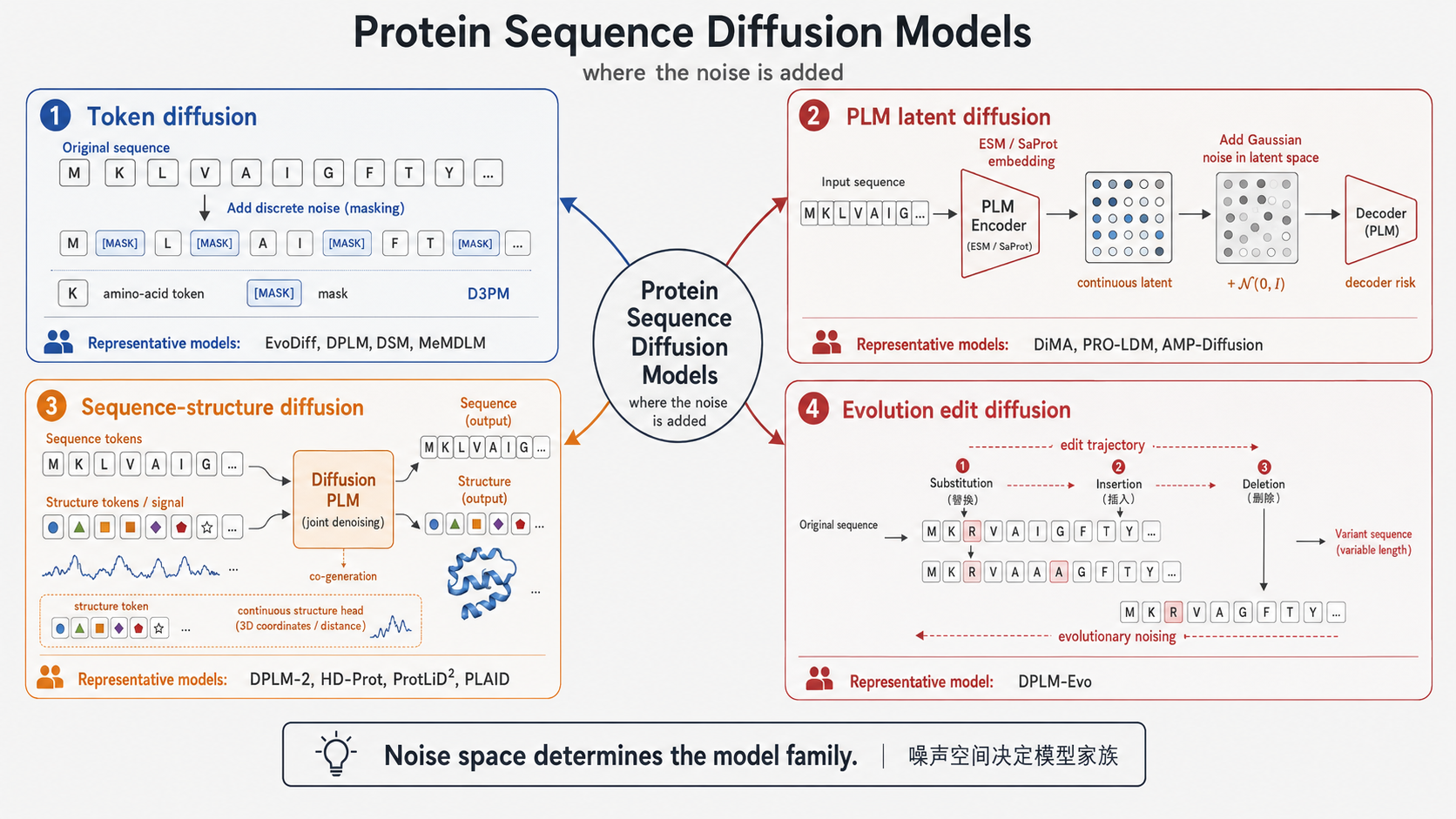
差别只在一件事:噪声落在哪里。落在 amino-acid token 上,就是离散序列扩散。落在 ESM、ESMc、SaProt 这类 PLM embedding 上,就是 latent diffusion。落在 sequence token 和 structure token 上,就是多模态 diffusion PLM。落在 substitution、insertion、deletion 上,就是 evolution-style edit diffusion。
为什么直接在序列上做
结构优先的蛋白设计很强。先生成 backbone,再用 ProteinMPNN 一类模型配序列。RFdiffusion 就是这条路的代表。
但不是所有蛋白都适合先问结构。IDR、低复杂度区域、短肽、跨膜蛋白,未必有稳定单一构象。此时 sequence prior 比 structure prior 更直接。
EvoDiff 就从这里出发。它不先生成 3D backbone,而在 sequence space 中生成蛋白。Microsoft Research 对它的描述也强调两点:evolutionary-scale data,diffusion conditioning。
EvoDiff 主要用了两类离散噪声。
OADM(order-agnostic autoregressive diffusion):每一步 mask 一个位置,直到全序列被 mask。反向时不固定顺序,任意位置都可恢复。
D3PM(discrete denoising diffusion):用转移矩阵腐化 token。uniform 版本走向均匀氨基酸分布。BLOSUM 版本偏向保守突变,更接近生物替换。
EvoDiff 的要点不是模型规模,而是立场:序列本身已经带有进化、功能和可折叠性的统计痕迹。对很多对象,不必先绕到结构空间。
Mask diffusion 的基本形式
连续 diffusion 通常写成:
训练目标常写成噪声预测:
这适合图像、坐标、连续 latent。氨基酸 token 不适合直接加 Gaussian noise。加噪后的点不是合法残基,也不一定能稳定投影回序列。
离散扩散把 Gaussian kernel 换成转移矩阵:
于是:
D3PM 的贡献,是把 \(Q_t\) 变成可设计对象。可以 uniform corruption。可以按 embedding 邻近关系腐化。也可以吸收到 absorbing state。
蛋白 PLM 最常用的 absorbing state,就是 [MASK]:
训练目标接近带时间权重的 masked language modeling:
普通 MLM 只学固定 mask ratio。masked diffusion 学整条时间轴。低噪声阶段补细节。高噪声阶段重建整体序列。MDLM 进一步说明,这类目标可以看成多组 masked cross entropy 的混合,也让 encoder-only model 有了明确采样过程。
DPLM:从 MLM 到生成式 pLM
DPLM 的核心,是把 discrete diffusion 写成 protein language model pretraining。
MLM 擅长表示学习,但没有完整生成路径。Autoregressive LM 能生成,但顺序是单向的。蛋白残基的依赖来自三维折叠,不天然服从左到右顺序。
DPLM 保留双向 Transformer,再加入 discrete diffusion。模型既看全局上下文,也能从噪声采样序列。论文在 UniRef50 上训练,约 4500 万条序列,约 140 亿 amino-acid tokens。模型规模为 150M、650M、3B。
采样过程可以写成:
每一步预测所有 masked positions。高置信 token 固定。低置信 token 继续 remask。生成不是一次性输出,而是多轮重采样。
motif scaffolding 也因此直接:
固定 motif,重采样 scaffold。DPLM 的 Figure 1 应优先看。它把 unconditional generation、representation learning、conditional generation 放在同一模型下。
DPLM 还处理 classifier guidance。离散 token 没有连续 score 的小步移动。做法是把 one-hot 放到概率单纯形,用属性模型改变 categorical sampling:
含义很直接:每轮重采样时,提高符合目标属性的残基概率。
DSM 和 MeMDLM:把已有 pLM 改成 diffusion
DSM 不是重造 pLM,而是把 ESM2-style encoder 改成 masked diffusion sequence model。它使用 LLaDA-style masked forward diffusion。在 90% token corruption 下,模型仍要恢复序列。
DSM 的 Figure 1 展示了两件事。普通 DSM 学序列恢复。DSM-ppi 加入 target sequence,让 binder 在目标蛋白上下文中去噪。目标不只是筛选条件,而是生成条件。
MeMDLM 把 MDLM 用到 membrane protein design。它以 ESM-2-150M 为 denoising backbone,采用 SUBS parameterization。未 mask 的 token 保持不变。被 mask 的 token 必须 unmask。论文把最大 masking rate 设为 75%,避免全 mask 时上下文消失。
膜蛋白适合这类模型。TM helix、loop、可溶区、motif 混在同一条序列里。结构数据少。局部改造又要保 topology。mask diffusion 可以固定 TM motif,只改周边序列。
Latent diffusion:连续空间的收益和代价
离散 token 精确,但不平滑。guidance 难,长度变化也难。另一种做法,是先用 PLM encoder 把序列变成 continuous representation,再在 latent 上扩散。
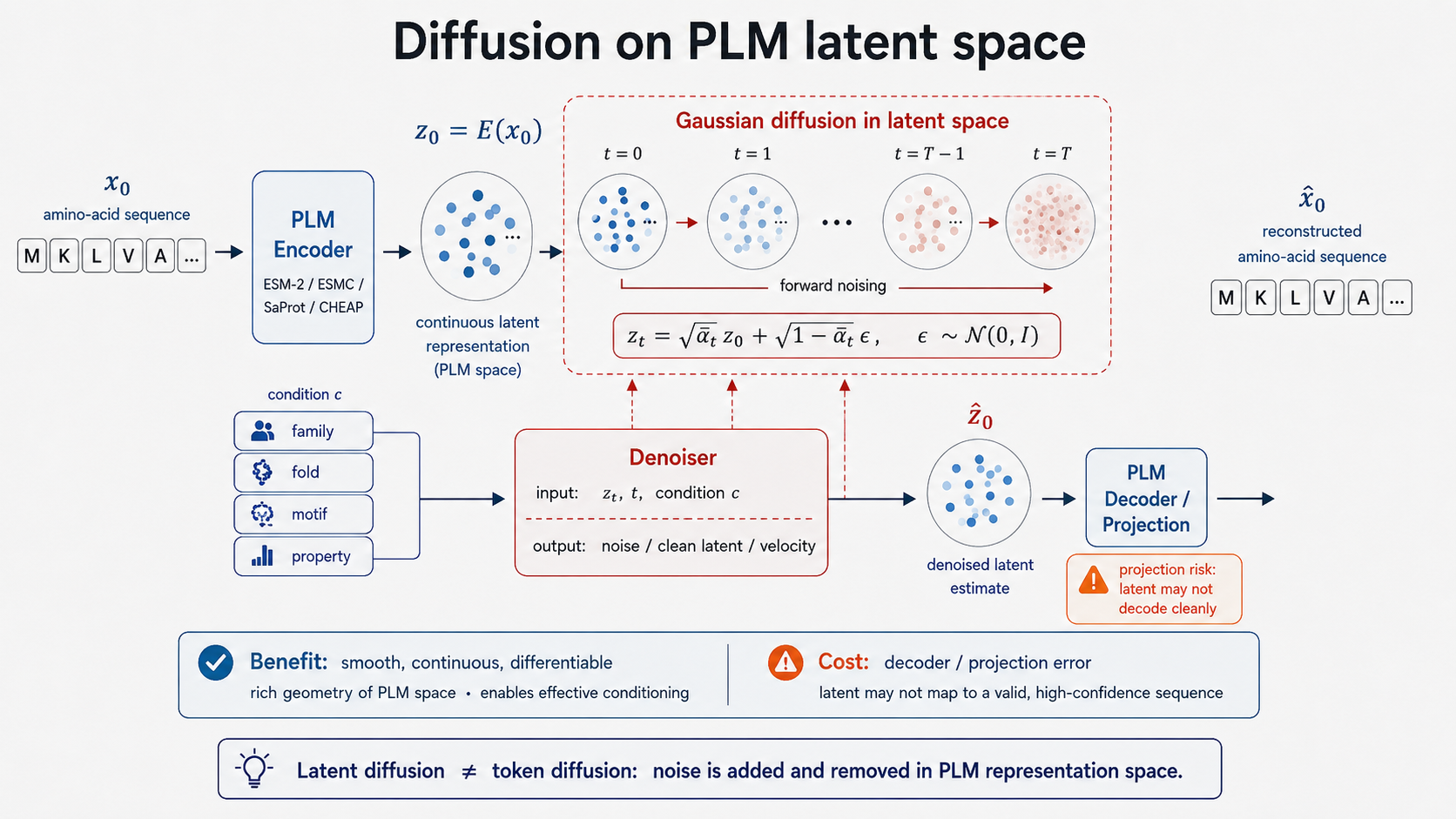
DiMA 是这条线的代表。它把 protein sequence 映射到 PLM representation,在 representation 上训练 denoising diffusion,再解码回序列。论文比较了 ESM-2、ESMc、CHEAP、SaProt 等 encoder,规模从 8M 到 3B。
公式就是连续 diffusion,只是对象换成 \(z_0=E(x_0)\):
条件 \(c\) 可以是 family、fold、motif、property。采样得到 \(\hat{z}_0\),再解码成 \(\hat{x}_0\)。
DiMA 的实验说明,encoder 尺寸会影响生成质量。AFDBv4-90 上,ESM-2 从 8M 到 3B,pLDDT 从约 74.3 到约 83.4。质量上升,多样性未必同步上升。
latent diffusion 适合 family generation、fold-specific design、属性条件生成。优势是连续、可微、条件好接。代价是 projection problem:采样出的 latent 不一定能解码成合理序列。
PRO-LDM 用 conditional latent diffusion 做 full-length sequence design。AMP-Diffusion 面向 antimicrobial peptide。ForceGen 和 VibeGen 把 mechanical response、unfolding curve、normal mode vibration 作为条件。它们说明 PLM latent 不只表达 fold,也能承载功能和物性目标。
结构 token:把 3D 带进 pLM
序列决定结构。结构也筛选序列。多模态 diffusion PLM 想把二者放进同一个去噪过程。
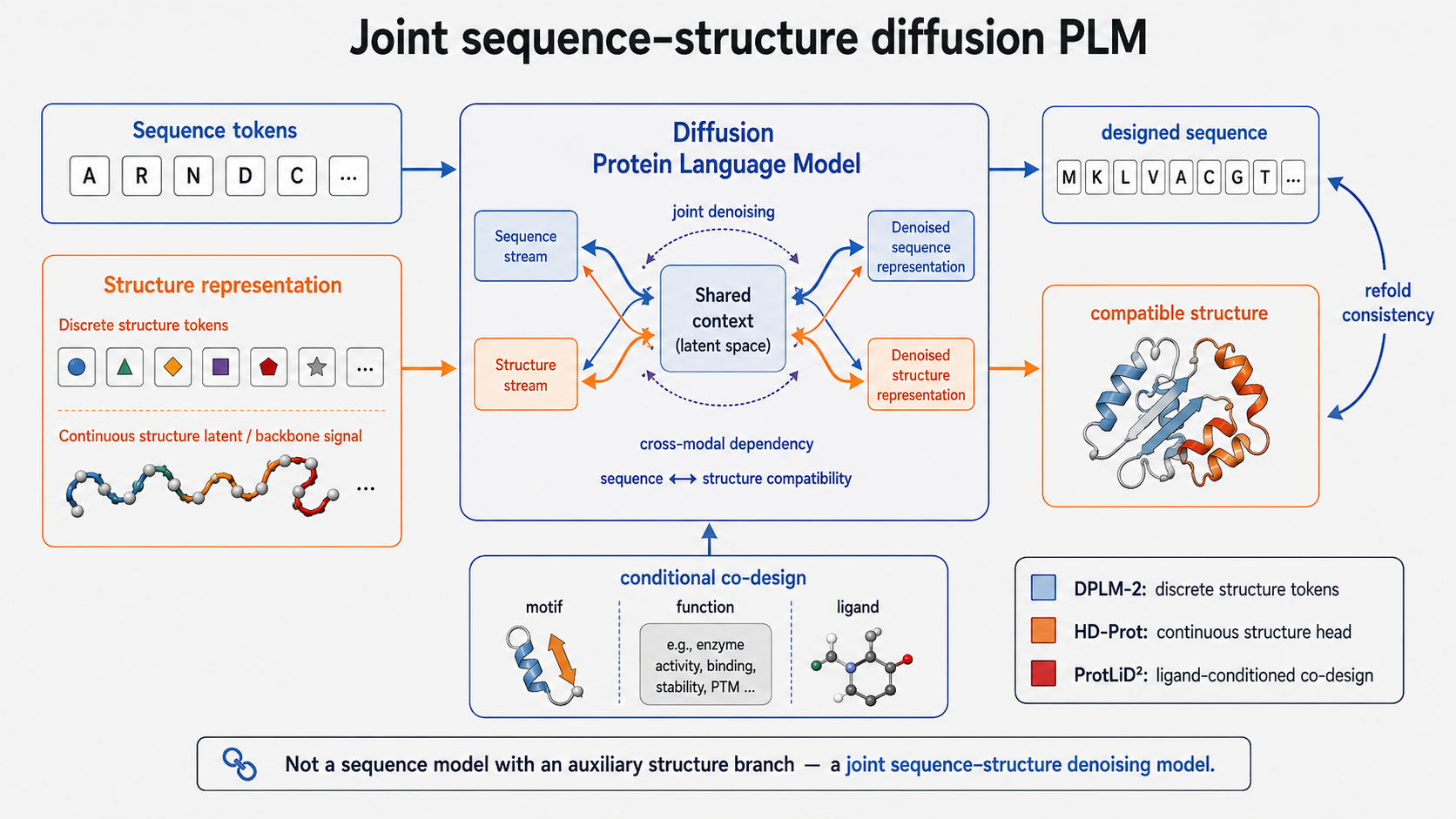
DPLM-2 是 DPLM 的序列-结构版本。模型同时处理 amino-acid token 和 structure token。流程是:structure encoder 编码 backbone 3D coordinates,lookup-free quantization 量化成 structure token,decoder 重建坐标。
DPLM-2 的 Figure 2 重点看 tokenizer。LFQ 比 VQ-VAE 更易训练,重构更好。论文报告 8192 codebook size 在压缩和重构之间较稳。
Figure 3 重点看 co-generation。模型同时生成序列和结构,再用 ESMFold refold 生成序列。关键指标不是单看序列或结构,而是 refolded structure 是否接近 generated structure。
DPLM-2 把任务统一成三个概率对象:
co-generation、folding、inverse folding、motif scaffolding,只是条件不同。
问题在于,structure token 有损失。DPLM-2.1 指出,瓶颈不只来自 tokenizer reconstruction loss,也来自 PLM 对 structure token 的预测误差。结构被压成 index 后,错一个 token 可能造成明显几何偏差。
DPLM-2 Bit 的思路是把结构监督拆细。不要只预测硬 index。用 bit-wise 或更细粒度的目标降低量化误差。
HD-Prot 走得更直接:序列保留 categorical prediction,结构交给 continuous diffusion head。
这比强行把所有结构信息压成 token 更合理。序列离散,结构连续,各自用适合的分布建模。
条件设计:从能生成到能约束
真实蛋白设计不是单条件任务。配体要结合。口袋要成形。motif 要固定。整体还要可折叠、可表达、可溶。
ProtLiD² 把 ligand condition 加进离散 sequence-structure co-design。模型同时生成 amino-acid sequence 和 discrete structure tokens,并用 geometry-aware cross-attention 接入 ligand 的化学和几何信息。它还提出 ReMask decoding:保留高置信 token,重新 mask 低置信 token。
MMCP-GEN 处理多模态条件接口。structure、function、ligand、text 通过 learnable queries 和 modality indicator heads 进入 diffusion backbone。
难点不是把条件拼进去,而是条件冲突。稳定性可能伤害功能。固定 motif 可能降低 foldability。配体口袋可能改变整体拓扑。diffusion PLM 需要学会在采样中协调约束,而不是只叠加 conditioning vectors。
DPLM-Evo:编辑,而不是重生
masked diffusion 默认从全 mask 生成。真实进化不是这样。蛋白通常从已有序列出发,经过 substitution、insertion、deletion。
DPLM-Evo 把 denoising action 改写成进化编辑:
长度变化是核心难点。DPLM-Evo 引入 upsampled-length latent alignment space。观测序列 \(x\) 对齐到带 gap 的 latent 序列 \(z\):
删除是 amino acid 变 gap。插入是 gap 长出新 token。替换是非 gap 位置换残基。
它还把 noising kernel 生物化。uniform mutation 不区分 Ile 到 Leu 和 Trp 到 Asp。BLOSUM-informed kernel 写成:
\(S_{ij}\) 是 BLOSUM62 的 log-odds score。\(\tau\) 控制熵。\(\tau\rightarrow\infty\) 接近 uniform。\(\tau\rightarrow 0\) 偏向保守突变。
更进一步的是 contextualized kernel。同一个氨基酸,在不同序列上下文里,突变倾向不同。DPLM-Evo 把生成过程写成可解释的变体轨迹,更贴近 directed evolution 和 protein optimization。
读论文先看哪些图
| 论文 / 项目 | 先看 | 看什么 |
|---|---|---|
| EvoDiff | README overview 和论文方法图 | OADM、D3PM、MSA diffusion 如何落在 sequence space。 |
| DPLM | Figure 1 | generation、representation、conditional sampling 如何共用一个 diffusion PLM。 |
| DPLM-2 | Figure 2 和 Figure 3 | LFQ tokenizer,以及 sequence-structure co-generation。 |
| DiMA | Figure 1 和 encoder 表格 | PLM encoder、denoiser、decoder 的三段式流程。 |
| DSM | Figure 1 | ESM2-style pLM 如何改成 masked diffusion。 |
| MeMDLM | Figure 1 | SUBS noising / denoising 如何服务膜蛋白设计。 |
| DPLM-Evo | Figure 1 和 sampling algorithm | mask recovery 如何变成 substitution / insertion / deletion。 |
| ProtLiD² | model overview 和 ReMask decoding | ligand geometry 如何进入 token-space co-design。 |
怎么选
固定 motif、补 loop、局部重设计:优先离散 masked diffusion。约束是 token 级,直接 clamp。
family generation、fold-specific design、属性控制:优先 latent diffusion。连续空间平滑,条件容易接,代价是 decoder 风险。
序列和结构同时生成:看 DPLM-2、HD-Prot、PLAID、ProtLiD²。重点是 refold 后是否仍接近生成结构。
已有蛋白优化:看 DPLM-Evo、guided discrete diffusion、LaMBO-2。目标是编辑轨迹,不是从全 mask 重生。
膜蛋白:看 MeMDLM / MemDLM。短肽和 AMP:看 AMP-Diffusion、PepTune、High-PepBinder。配体口袋:看 ProtLiD²、MMCP-GEN,以及 RFdiffusion3、BoltzGen 这类 all-atom 方法。
当前瓶颈
评价间接。pLDDT、TM-score、scRMSD 能筛 foldability,不能替代表达、活性、毒性、免疫原性和真实 binding。
结构 token 有损失。DPLM-2 证明路线可行。DPLM-2.1 和 HD-Prot 说明离散 index 还不够。
guidance 会冲突。稳定性、功能、溶解性、口袋几何、motif 保真,往往不能同时最优。
长度变化难。mask diffusion 天然偏固定长度。DPLM-Evo 是进展,但 variable-length generation 仍不成熟。
PLM prior 和 all-atom geometry 尚未合拢。前者懂进化统计。后者懂空间相互作用。后续强模型大概率会把二者接起来。
最后一层抽象
蛋白序列扩散模型,不是一种算法,而是一组关于噪声空间的选择。
EvoDiff 证明 sequence-space diffusion 可行。DPLM 把 diffusion 变成 pLM pretraining。DiMA 把噪声放进 PLM latent。DPLM-2 和 HD-Prot 把结构并入生成过程。DPLM-Evo 把去噪改写成进化编辑。
读模型时,先问它在哪里加噪声。这个问题回答清楚,公式、条件接口、优势和失败模式都会清楚。
参考文献
- Austin et al., Structured Denoising Diffusion Models in Discrete State-Spaces, 2021.
- Sahoo et al., Simple and Effective Masked Diffusion Language Models, 2024.
- Alamdari et al., Protein generation with evolutionary diffusion: sequence is all you need, bioRxiv 2024, EvoDiff GitHub.
- Wang et al., Diffusion Language Models Are Versatile Protein Learners, ICML 2024.
- Wang et al., DPLM-2: A Multimodal Diffusion Protein Language Model, 2024.
- Meshchaninov et al., Diffusion on Language Model Encodings for Protein Sequence Generation, 2024.
- Hallee et al., Diffusion Sequence Models for Enhanced Protein Representation and Generation, 2025.
- Goel et al., MeMDLM: De Novo Membrane Protein Design with Masked Discrete Diffusion Protein Language Models, 2024.
- Wang et al., Towards A Generative Protein Evolution Machine with DPLM-Evo, 2026.
- Zhou et al., HD-Prot: A Protein Language Model for Joint Sequence-Structure Modeling with Continuous Structure Tokens, 2025.
- Wei et al., Ligand-Conditioned Discrete Diffusion for Protein Sequence-Structure Co-Design, 2026.
- Yin et al., CFP-Gen: Combinatorial Functional Protein Generation via Diffusion Language Models, 2025.
- An et al., MMCP-GEN: A Modality-Extensible Diffusion Language Model for Conditional Protein Sequence Generation, CVPR 2026.